what is a good cb radio that you can listen to police find man

An Icom IC-R5 hand-held scanner
A scanner (also referred to as a radio scanner) is a radio receiver that can automatically tune, or scan, two or more discrete frequencies, stopping when information technology finds a betoken on one of them and then continuing to scan other frequencies when the initial manual ceases.
The term scanner generally refers to a communications receiver that is primarily intended for monitoring VHF and UHF landmobile radio systems, every bit opposed to, for instance, a receiver used to monitor international shortwave transmissions.
By and large, these scanners tin besides tune to different types of modulation every bit well (AM, FM, WFM, etc.). Early scanners were deadening, bulky, and expensive. Today, mod microprocessors have enabled scanners to store thousands of channels and monitor hundreds of channels per 2nd. Recent models tin can follow trunked radio systems and decode APCO-P25 digital transmissions. Both hand held and desktop models are available. Scanners are ofttimes used to monitor police, fire and emergency medical services. Radio scanning serves an of import role in the fields of journalism and crime investigation, as well as a hobby for many people around the earth.
History and employ [edit]
Scanners developed from earlier tunable and fixed-frequency radios that received one frequency at a time. Not-broadcast radio systems, such as those used past public condom agencies, do non transmit continuously. With a radio fixed on a single frequency, much time could pass between transmissions, while other frequencies might be active. A scanning radio will sequentially monitor multiple programmed channels, or search between user defined frequency limits. The scanner will finish on an active frequency stiff enough to pause the radio'southward squelch setting and resume scanning other frequencies when that activity ceases.
Scanners first became popular and widely bachelor during the heyday of CB radio in the 1970s. The first scanners often had between four and ten channels and required the purchase of a carve up crystal for each frequency received. A The states patent was issued to Peter W. Pflasterer on June 1, 1976.[i] An early 1976 United states of america entry was the Tennelec MCP-1, sold at the January 1976 Consumer Electronics Testify in Chicago.[2]
Features [edit]

Many contempo models will permit scanning of the specific DCS or CTCSS code used on a specific frequency should it have multiple users. I retentiveness bank can be assigned to air traffic control, another can be for local marine communications, and yet another for local police frequencies. These can be switched on and off depending on the user's preference. Almost scanners accept a weather condition radio band, allowing the listener to tune into weather radio broadcasts from a NOAA transmitter.
Some scanners are equipped with Burn down-Tone out. Burn down tone out decodes Quick Phone call type tones and acts as a pager when the right sequence of tones is detected.
Modern scanners permit hundreds or thousands of frequencies to be entered via a keypad and stored in various 'memory banks' and can scan at a rapid rate due to modern microprocessors.
Agile frequencies can exist found by searching the cyberspace and frequency reference books[3] or can be discovered through a programmable scanner's search function. An external antenna for a desktop scanner or an extendable antenna for a hand held unit will provide greater functioning than the original equipment antennas provided past manufacturers.
Uses [edit]
Scanners are oft used by hobbyists, railfans, aviation enthusiasts, automobile race fans, siren enthusiasts, off-duty emergency services personnel, and reporters.
Many scanner clubs exist to permit members to share information nearly frequencies, codes, and operations. Many have net presence, such as websites, electronic mail lists or spider web forums.
Legislation [edit]
Australia [edit]
Information technology is legal to possess a scanner in Australia. It is legal to heed to any transmission that is not classified as telecommunications (i.due east. anything not connected to the telephone network).[ citation needed ]
Austria [edit]
Possession of a radio scanner is legal. Even so, article 93 of the Telekommunikationsgesetz prohibits the intentional reception of signals by tertiary parties without authorization from the user.[4]
Brazil [edit]
In Brazil it is legal to have a scanner, but the user should have a ham radio license. Individuals are prohibited from spreading or recording any data obtained.[ citation needed ]
Canada [edit]
In Canada, according to the Radiocommunication Act,[5] it is completely legal to install, operate or possess a radio appliance that is capable simply of the reception of broadcasting (digital and counterpart, only non encrypted information) provided that private information is non passed on or disclosed to any other person(s) or political party(s).
A situation that occurred in the Toronto area on 28 June 2011 involving York Regional Police officer Constable Garrett Styles was picked up by scanners. On-line streaming of communications between the officer and police dispatch while the fatally injured officer was in urgent need of emergency aid were picked up past local media. The tragedy was widely reported earlier the officer'south family was notified. Several media outlets rebroadcast the recorded emergency transmission. A constabulary initiative pressuring the government to create legislation to end online streaming of scanner captured police communications was announced in Apr 2012.[6] Although it is currently legal to stream information from a scanner in Canada[ citation needed ], using the information for profit is not legal. Some Canadian constabulary forces apply encrypted communications which cannot legally exist decrypted and streamed onto the Internet. Applications are available permitting anyone with an Cyberspace ready reckoner or smart telephone to access scanner communications that are streamed onto the Net by individual individuals who possess the appropriate scanner and computer equipment.
Frg [edit]
German language law does not prohibit possession of a scanner. However. the Abhörverbot laid down in commodity five of the Telekommunikation-Medien-Datenschutz-Gesetz (TTDSG) stipulates that it is only legal to listen to or otherwise take noesis of the contents of four classes of transmissions: those intended for the user of the radio receiver, those made by licensed apprentice radio operators, those intended for the full general public, and those intended for an indefinite group of people.[7] Violation of this provision is punishable by up to two years in prison house or a fine.[eight] This prohibition was previously included in the Telekommunikationsgesetz, just was moved to the TTSDG as a part of the German telecom police reform in 2021.[9]
Until 2016, the Telekommunikationsgesetz only prohibited the act of listening to other classes of transmissions. This was broadened equally a response to a determination of the Cologne Authoritative Courtroom, which in 2008 questioned whether the mere reception and decoding of shipping transponder signals to display aircraft movements on a screen could be considered listening, as it lacks an acoustic element.[10] This updated wording was carried over to the TTDSG in 2021.
Republic of ireland [edit]
Unlicensed possession of a wireless telegraphy appliance is generally prohibited under Department three of the Wireless Telegraphy Act 1926, subject field to exemptions.[xi] Ane such exemption covers most apparatuses only capable of reception, including radio scanners.[12]
Moreover, Department 11(2) of the Act states that "no person shall improperly divulge the purport of whatsoever message, communication, or signal sent or proposed to be sent by wireless telegraphy."[xiii] The aforementioned exemption echoes this wording equally a condition of use of covered receive-only apparatuses.[14] No further information regarding the telescopic of this prohibition is provided.
The Airport Bye-Laws for Cork Airport and Dublin Airport specifically ban monitoring air traffic control or airport or airline operational frequencies with radio receiving or recording equipment.[15]
Italian republic [edit]
Owning a scanner that is able to intercept the frequencies of law enforcement, is illegal and carries a jail sentence from ane to five years. Art. 617 bis Civil Penal Lawmaking.[sixteen]
Japan [edit]
Information technology is legal to possess, install and operate a scanner in Nippon. The radio law prohibits from disclosing or passing on data received to other persons and using the information to gain personal profit. It is illegal to mind to telephone communication and those transmitted using tapping devices. An amateur radio license is required when amateur radio apparatus is used to listen to radio.[ commendation needed ]
Mexico [edit]
In Mexico information technology is legal to accept an unblocked scanner and listen to any radio spectrum frequencies including encrypted and cellular band. According to the Federal Law of General Means of Advice, individuals are prohibited from spreading whatsoever information obtained via the mass media.[17]
Netherlands [edit]
In the Netherlands it is legal to heed to whatever radio spectrum frequency because of the "liberty of information"-doctrine However, if a "special" (i.east., unusual) effort is needed to intercept the information on a frequency (such as decrypting encrypted traffic or using an unauthorized scanner) then information technology is considered illegal.[xviii] In 2008, the Dutch Supreme Courtroom ruled that receivers that can solely be used to detect certain frequencies (such as radar detectors) are illegal because they cannot be used to "convey noesis or thoughts" and thus are non covered by the same doctrine.[19]
New Zealand [edit]
In New Zealand, co-ordinate to the Radiocommunications Act 1989[20] it is legal to possess and utilize a scanner at any time to melody to any individual voice radio (non encrypted data) provided that private information is non passed on or disclosed to whatsoever other person(due south) or party(southward).
Switzerland [edit]
Possession of a radio scanner is legal in Switzerland. Nevertheless, it may only be used to listen to public radio traffic like CB radio and amateur radio. In addition to public radio traffic, listening to airband frequencies is also allowed.[21]
United Kingdom [edit]
In the UK it is not illegal to own or use a scanner except in detail circumstances. For example, particular transmissions or frequencies should simply be listened to with authority [22] an example of this being Uk aviation frequencies, which in many other countries may be publicly listened to (and are even available to be streamed online[23]) but in the UK are restricted.[24]
Usa [edit]
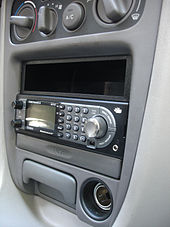
A Uniden scanner installed in a vehicle. Some US states prohibit this unless the operator has an FCC issued radio license
The legality of radio scanners in the U.s. varies considerably between jurisdictions, although information technology is a federal criminal offence to monitor cellular phone calls. V The states states restrict the use of a scanner in an automobile.[25] Although scanners capable of following trunked radio systems and demodulating some digital radio systems such equally APCO Project 25 are available, decryption-capable scanners would exist a violation of U.s. police and possibly laws of other countries.[ citation needed ]
A constabulary passed past the Congress of the United States, under the pressure from cellular telephone interests, prohibited scanners sold later on a certain date from receiving frequencies allocated to the Cellular Radio Service. The constabulary was after amended to make it illegal to modify radios to receive those frequencies, and also to sell radios that could be easily modified to do and so.[26] This police remains in effect fifty-fifty though no cellular subscribers still use analog applied science. In that location are Canadian and European unblocked versions available, but these are illegal to import into the U.S. Frequencies used by early cordless phones at 43.720–44.480 MHz, 46.610–46.930 MHz, and 902.000–906.000 MHz tin can exist picked up by many scanners. The proliferation of scanners led most cordless phone manufacturers to produce cordless handsets operating on a more secure 2.4 GHz arrangement using spread-spectrum applied science. Certain states in the United states such every bit New York and Florida, prohibit the use of scanners in a vehicle unless the operator has a radio license issued from the Federal Communications Committee (FCC) (Amateur Radio, etc.)[27] [28] or the operator'south chore requires the apply of a scanner in a vehicle (eastward.g., police force, fire, utilities).[ citation needed ] Many scanner user manuals include a warning saying that, while it is legal to listen to almost every transmission a scanner tin can receive, merely there are some that persons should not intentionally listen to (such equally telephone conversations, pager transmissions, or any scrambled or encrypted transmissions) under the Electronic Communications Privacy Act, and that modifications to practice so are illegal.[29]
In some parts of the United states, there are actress penalties for the possession of a scanner during a crime, and some states, such as Michigan, as well prohibit the possession of a scanner by a person who has been convicted of a felony in the terminal v years.[thirty]
Many people including siren Enthusiasts, aviation enthusiasts, and more use scanner audio or footage and post them online. Older people who are involved in these group (mainly siren enthusiasts) have said that putting siren activation tones in videos is either illegal or unsafe. Their reasoning is that in 2022 a very big siren system in Dallas, Texas had been hacked and all of the sirens in Dallas Canton went off in the centre of the night. According to some siren enthusiasts the hack was done by using a 2-way radio and using a video online using activation tones from Dallas Canton's dispatch heart. The hacker and then transmitted the video with tones in information technology over the dispatch frequency which lead to all of the sirens going off in Dallas. More of these hacks happened in places such equally Cincinnati, Ohio, Milwaukee, Wisconsin and other cities. Afterward this many siren enthusiasts stopped putting activation tones in videos so that they wouldn't exist used maliciously. A lot of arguments in the siren customs accept spun up after these hacks. Some enthusiasts began altering or pitch shifting tones so that they don't sound like the real activation tones and some nonetheless keep them in there, still they put a disclaimer in the description of the video saying they will non be held responsible for misuse of activation tones. The reason why activation tones are in videos in the first identify is to alarm the enthusiasts of when said siren is about to get off. With this being in heed, this is what some sources say about putting scanner sound in videos (including tones). Section 705 of the Communications Act States that: No person not being authorized past the sender shall intercept whatsoever radio communication and divulge or publish the existence, contents, substance, purport, effect, or meaning of such intercepted communication to any person. 47 U.S.C. § 605(a). The penalties for violating this section are severe: a fine of not more than $2000, imprisonment, or both or, where such violation is "willfull" and for purposes of direct or indirect commercial advantage or private financial proceeds," a fine of upward to $l,000 and imprisonment of not more two years for the get-go such conviction and up to $100,000 and five years for subsequent convictions. In addition, the statute provides for a private civil remedy to any person aggrieved by a violation of this section. The FCC regulations implementing this section more than specifically provide that messages originated by "privately-owned non-circulate stations . . . may be broadcast just upon receipt of prior permission from the non-broadcast licensee." When people read this, they took information technology as putting scanner broadcasts online is illegal. This is not true because information technology merely refers to the Interception of broadcasts. Which means it is still legal to put scanner audio in videos only you cannot re-broadcast them over said frequency. Since most Police force, Burn, European monetary system, and Public Safety frequencies are public and publicly available in the FCC Database, you can still put audio in videos no affair what the sound is.
In the Usa, Licensed Apprentice Radio Operators with a valid FCC License may possess Amateur Radio Transceivers capable of reception across the Apprentice Radio Bands per an FCC Memorandum & Order known as FCC Docket PR91-36 (too known as FCC 93-410).[31] [32]
See also [edit]
- Ii-way radio
- Trunked radio system
- Communications receiver
- Uniden
References [edit]
- ^ Patent US3961261 - Crystalless scanning radio receiver patents.google.com.
- ^ Curtis, Anthony R. (July 1977). "Computerized scanners". Popular Mechanics. 148 (one): 68–70. Retrieved one June 2011.
- ^ Kneitel, Tom (1986). The "Top Secret" registry of U.Southward. Government radio frequencies. Commack, NY: CRB Research. ISBN0-939780-06-2.
- ^ "§ 93(three) Telekommunikationsgesetz". Retrieved 2021-10-23 .
{{cite spider web}}: CS1 maint: url-condition (link) - ^ Radiocommunication Act: An Human action respecting radiocommunication in Canada. R.S., 1985, c. R-2, s. 1; 1989, c. 17, s. 2. [ dead link ]
- ^ Gonczol, David (13 Apr 2012). "Police Promise to End Rebroadcasting of Scanners". Ottawa Citizen . Retrieved xiv Apr 2012.
- ^ "§ v TTDSG". Retrieved 2022-01-26 .
{{cite web}}: CS1 maint: url-status (link) - ^ "§ 27 TTDSG". Retrieved 2022-01-26 .
{{cite web}}: CS1 maint: url-status (link) - ^ "Bundestag beschließt Reform des Telekommunikationrechts". Retrieved 2022-01-26 .
- ^ "1 L 1048/08, VG Köln, para ten".
{{cite web}}: CS1 maint: url-status (link) - ^ "Wireless Telegraphy Deed, 1926, Section 3(1),". Retrieved 2022-01-26 .
- ^ "South.I. No. 197 of 2005". Retrieved 2022-01-26 .
- ^ "Wireless Telegraphy Human action, 1926, Section 11(2)". Retrieved 2022-01-26 .
- ^ "Article 5, S.I. No. 197 of 2005". Retrieved 2022-01-26 .
- ^ "Airport Bye-Laws 2022 (South.I. No. 618 of 2014), Office Three, Section 21".
- ^ "Art. 617 bis codice penale - Installazione di apparecchiature atte ad intercettare od impedire comunicazioni o conversazioni telegrafiche o telefoniche". Brocardi.it . Retrieved 22 September 2018.
- ^ "Ley de Vías Generales de Comunicación - 73" (PDF).
- ^ "Vrije signalen uit de ether - ICTRecht juridisch adviesbureau". Retrieved 22 September 2018.
- ^ Raad, Parket bij de Hoge (8 April 2008). "ECLI:NL:PHR:2008:BC4284, voorheen LJN BC4284, Parket bij de Hoge Raad, 03362/06". Retrieved 22 September 2018.
- ^ "Radiocommunications Act 1989 No 148 (equally at 28 September 2017), Public Act Contents – New Zealand Legislation". world wide web.legislation.govt.nz . Retrieved 22 September 2018.
- ^ "Frequenznutzungen". BAKOM.
{{cite web}}: CS1 maint: url-status (link) - ^ "Archived copy". Archived from the original on 2016-08-07. Retrieved 2016-08-05 .
{{cite web}}: CS1 maint: archived copy as title (link) - ^ "Listen to Live ATC (Air Traffic Command) Communications - LiveATC.internet". www.liveatc.net . Retrieved 22 September 2018.
- ^ "The constabulary regarding listening to Uk air traffic. - Heathrow Drome Information". 12 Apr 2011. Retrieved 22 September 2018.
- ^ "Are Law Scanners Legal? Police Scanner Laws in the U.S." world wide web.zipscanners.com . Retrieved 22 September 2018.
- ^ FCC (1997-07-x). DA 97-1440: Manufacturing Illegal Scanners Includes Scanner Modification. Federal Communications Commission, 10 July 1997. Retrieved from http://www.fcc.gov/Bureaus/Engineering_Technology/Public_Notices/1997/da971440.txt.
- ^ §397 Equipping motor vehicles with radio receiving sets
- ^ "Statutes & Constitution :View Statutes : Online Sunshine". www.leg.country.fl.us . Retrieved 22 September 2018.
- ^ "UB360 DIGITAL MOBILE TRUNKING SCANNER User Manual Uniden America". Retrieved 25 December 2020.
- ^ "Michigan Legislature - Section 750.508". legislature.mi.gov . Retrieved 22 September 2018.
- ^ FCC (1993-09-03). PR Docket 91-36: In the Affair of Federal Preemption of Country and Local Laws Concerning Amateur Operator Employ of Transceivers Capable of Reception Beyond Amateur Service Frequency Allocations—Memorandum Stance and Order. Federal Communications Commission, 3 September 1993. Retrieved from http://world wide web.arrl.org/files/file/pr91-36.pdf.
- ^ A partial copy of the Electronic Communications Privacy Act of 1986 can exist found at http://floridalawfirm.com/privacy.html with the following disclaimer: "This document was originally published by Florida Police force House in 1998. Information technology is no longer current and should not be relied upon for any reason."
External links [edit]
- Intro to the police or radio scanner at YouTube (2014)
- Constabulary Scanner Radio Resources & Learning Centre
- Are Law Scanners Legal in the US?
- Radio Reference Website
Source: https://en.wikipedia.org/wiki/Radio_scanner
0 Response to "what is a good cb radio that you can listen to police find man"
Post a Comment