James Stuart Bell Books How Well Do You Know the Bible Quiz
Why is the King James Bible so popular?
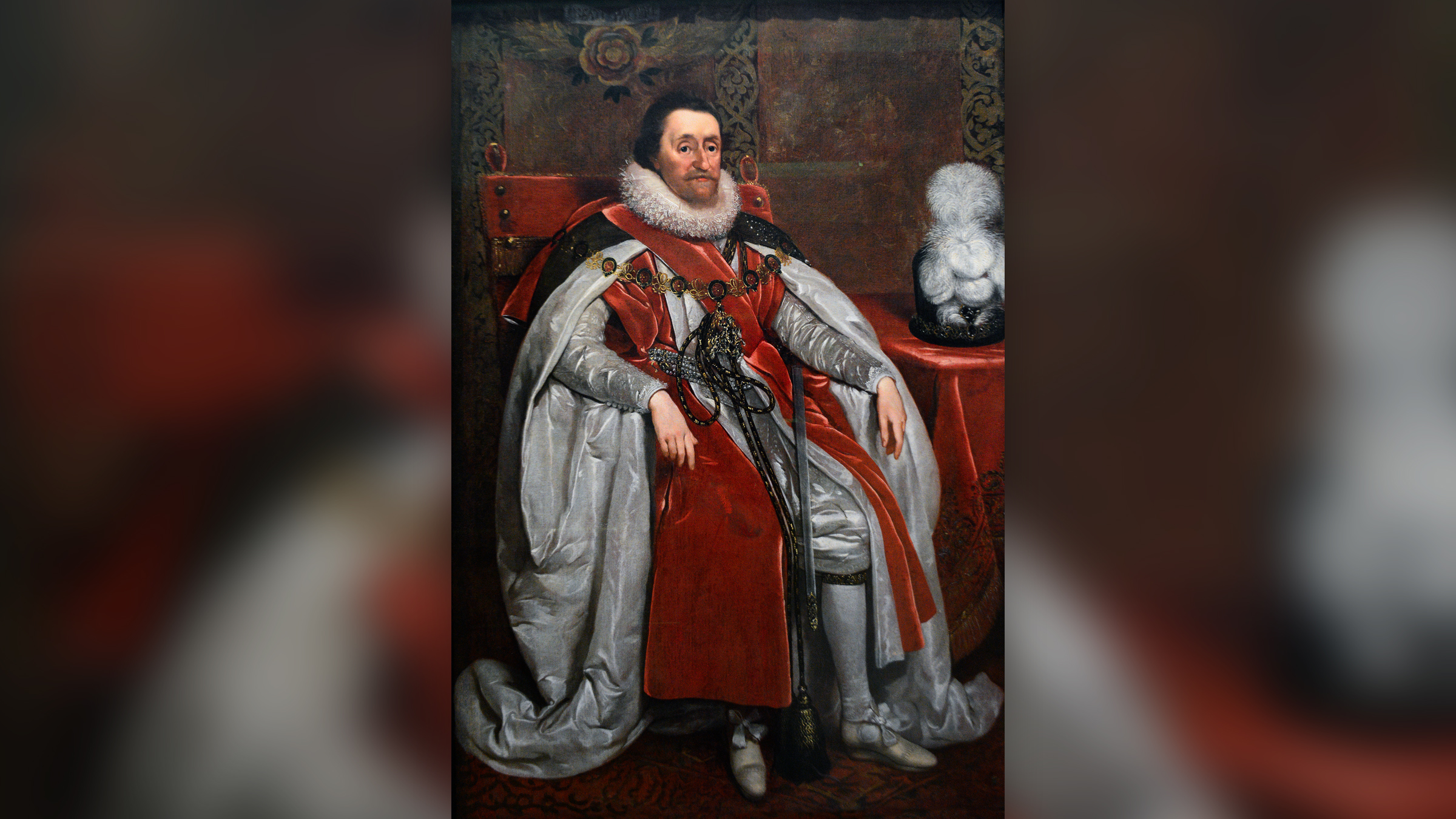
Soon after he ascended the English language throne in 1603, King James I deputed a new Holy Bible translation that, more than 400 years subsequently, is however widely read around the world.
This Bible, known equally the King James Version (KJV), helped King James exit behind a lasting cultural footprint — one of his goals as a leader. "James saw himself equally a smashing Renaissance effigy who wanted to impart on the globe culture, music, literature and even new means of learning," Bruce Gordon, a professor of ecclesiastical history at Yale Divinity School, told Live Science.
But given the KJV's historic period, why is it withal so popular beyond different Christian denominations?
Related: Why does Christianity have so many denominations?
In curt, the KJV's influence has waxed over the centuries because, Gordon said, it was the version that was most widely read and distributed in countries where English language was the dominant language and that its translation was "never really challenged until the 20th century." In that time, the KJV became and so embedded in the Anglo-American earth that "many people in Africa and Asia were taught English from the KJV" when Christian missionaries brought it to them, Gordon said. "Many people weren't even enlightened that it was ane of many available translations," he added, "they believed the Male monarch James Version was the Bible in English language."
But in that location's more than to the story that goes back to the translation's inception.
Why did Rex James want a newly translated Bible?
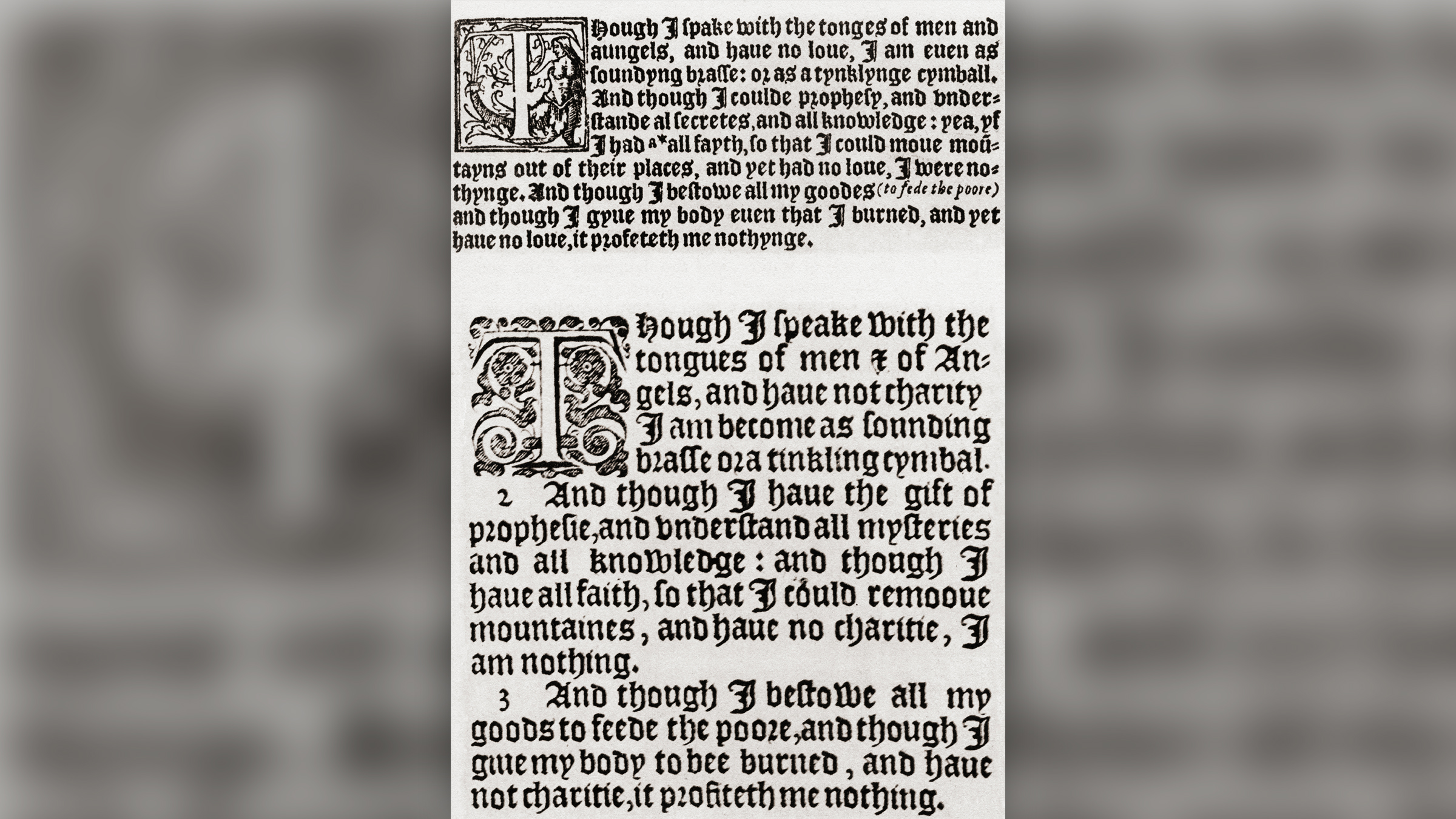
Before James commissioned the KJV in 1604, near people in England were learning from ii different Bibles — the Church of England'southward translation, commonly read during worship services (known as the Bishops' Bible, get-go published in 1568), and the more popular version virtually Brits read at home, known as the Geneva Bible, first published in 1560. The Geneva Bible was the Bible of choice among Protestants and Protestant sects, and as a Presbyterian, James likewise read that version. However, he disliked the lengthy and distracting annotations in the margins, some of which even questioned the ability of a male monarch, co-ordinate to Gordon.
What's more than, when James assumed the English throne in March 1603, following the death of Queen Elizabeth I, he inherited a complicated political state of affairs, as the Puritans and the Calvinists — religious followers of reformer John Calvin — were openly questioning the absolute power of the Church of England's bishops. James' ain mother — Mary, Queen of Scots — had been executed 16 years earlier in part because she was perceived to be a Catholic threat to Queen Elizabeth'south Protestant reign. "Mary's decease made James keenly aware of how easily he could be removed if he upset the wrong people," Gordon said.
To moderate such divisions, James commissioned a Bible that aimed to delight both parishioners of the Church of England and the growing Protestant sects past removing the problematic and unpopular annotations of the Geneva Bible while remaining truthful to the way and translations from both Bibles that each group revered. Despite James' efforts, Gordon said, "the KJV didn't really succeed while James was alive." That'due south considering the market for James' version didn't really arise until the 1640s, when Archbishop William Laud, who "hated the Puritans," suppressed the Geneva Bible that the Puritans followed, Gordon said.
James died from a stroke in March 1625, so he never saw his Bible become widely accustomed. But even during his lifetime, afterwards James deputed the translation, he didn't oversee the process himself. "It'due south nigh as if he got the ball rolling, then washed his easily of the whole thing," Gordon said.
Related: Was the 'forbidden fruit' in the Garden of Eden really an apple?
How the KJV was translated
To oversee the translation, James commissioned six committees made up of 47 scholars from the universities of Oxford and Cambridge. They were tasked with translating all of the Hebrew and Greek texts of the Old and New Testaments into English language. It was a complicated and sometimes contentious process that took seven years to complete. Though we don't accept a lot of the records of those committees, "through our best reconstructions, we understand information technology was a very rigorous debate with everyone committed to the almost accurate translation of the Bible," Gordon said.
Much of the resulting translation drew on the work of William Tyndale, a Protestant reformer who had produced the first New Testament translation from Greek to English in 1525. "It'southward believed that upward to 80% of the King James Version stems from the William Tyndale version," Gordon said.
Why is the KJV still popular today?
For a book that was published in 1611, it'south amazing how influential and widely read the KJV still is today. Though there are hundreds of versions and translations of the Bible, the KJV is the most popular. According to market research house Statistica, equally of 2017, more 31% of Americans read the KJV, with the New International Version coming in 2nd identify, at 13%. Five large denominations of Christianity — Baptist, Episcopalian, Presbyterian, Latter-day Saints and Pentecostal — use the KJV today.
The KJV "works every bit both a discussion-for-word and sense-for-sense translation," meaning information technology acts as both a literal translation of many of the words believed to have been used by Jesus Christ and his Apostles and accurately conveys the significant behind those words and events, Gordon said. One line of manuscripts used in the KJV — the Textus Receptus of Erasmus, translated from Greek to Latin by the 16th-century Dutch scholar and philosopher Desiderius Erasmus — is thought past some to be a particularly important inclusion in the KJV, especially for those who run into it as the purest line of the New Attestation going dorsum to the Churchly Historic period (A.D. 33 to 100), Gordon said.
Despite the KJV'south popularity throughout the centuries, Gordon said some scholars now view parts of it as outdated. He cautioned that in that location have been other ancient manuscripts discovered since the KJV was commissioned that heighten scholars' understanding of some biblical events and possibly even change the meaning of sure words.
Related: What led to the emergence of monotheism?
For example, in the mid-20th century, "many translators believed that 'maiden' or 'young woman' was a more accurate Hebraic translation to employ to describe Jesus' mother Mary, instead of 'virgin,'" Gordon said. If right, the interpretation would have far-reaching implications every bit the Old Testament prophet Isaiah had prophesied that the Messiah would be born of a virgin. "Translations," Gordon said, "are not neutral things."
To that finish, many KJV readers (known equally "King James Onlyists") don't believe the Bible should be updated at all and hold to the notion that James' version was translated from the most reliable manuscripts. What'due south more, Gordon said, some Onlyists believe that the scholars who oversaw the KJV translation were "divinely inspired" and that more modern translations should be overlooked considering they have been "carried out by nonbelievers."
Even casual religious observers or nonbelievers are affected past the prose of the KJV Bible in ways they may non realize. Its poetic language has influenced generations of artists and activists, with many biblical phrases becoming part of our everyday language. A few examples include "the blind leading the bullheaded," "the powers that be," "my brother'southward keeper," "by the skin of your teeth," "a wolf in sheep's clothing," "ascension and polish" and "get the extra mile," according to Wide Open State. Even the famous opening line "4 score and seven years ago" from President Abraham Lincoln's Gettysburg Address was inspired by language used in the KJV.
Originally published on Alive Science.

Daryl Austin is an editor and author based in Utah. He writes about history and health, including mental wellness and the COVID-19 pandemic. His work has been published past National Geographic, The Wall Street Journal, NBC News, The Guardian, Business Insider, The Atlantic, USA Today, The Washington Post and Newsweek.
James Stuart Bell Books How Well Do You Know the Bible Quiz
Source: https://www.livescience.com/why-king-james-bible.html
0 Response to "James Stuart Bell Books How Well Do You Know the Bible Quiz"
Post a Comment