How Do You Draw a Stem and Leaf Diagram
Stem and leafage plots
Archived Content
Data identified as archived is provided for reference, inquiry or recordkeeping purposes. It is not subject to the Authorities of Canada Spider web Standards and has not been contradistinct or updated since it was archived. Please contact the states to request a format other than those available.
- Elements of a practiced stem and leaf plot
- Tips on how to draw a stem and leaf plot
- Instance 1 – Making a stem and leaf plot
- The chief advantage of a stem and leaf plot
- Example 2 – Making a stem and leaf plot
- Example three – Making an ordered stem and leaf plot
- Splitting the stems
- Example 4 – Splitting the stems
- Example 5 – Splitting stems using decimal values
- Outliers
- Features of distributions
- Using stem and leaf plots as graphs
- Instance 6 – Using stem and leafage plots as graph
A stem and leaf plot, or stem plot, is a technique used to classify either discrete or continuous variables. A stem and leafage plot is used to organize data as they are collected.
A stem and leaf plot looks something like a bar graph. Each number in the data is broken down into a stem and a leaf, thus the name. The stem of the number includes all but the final digit. The leaf of the number volition ever be a single digit.
Elements of a good stem and leaf plot
A good stem and leaf plot
- shows the commencement digits of the number (thousands, hundreds or tens) every bit the stem and shows the last digit (ones) equally the leaf.
- usually uses whole numbers. Anything that has a decimal point is rounded to the nearest whole number. For case, test results, speeds, heights, weights, etc.
- looks like a bar graph when it is turned on its side.
- shows how the data are spread—that is, highest number, lowest number, most mutual number and outliers (a number that lies outside the main group of numbers).

Top of Folio
Tips on how to draw a stem and leaf plot
Once yous have decided that a stem and leaf plot is the best manner to show your data, depict it as follows:
- On the left manus side of the page, write down the thousands, hundreds or tens (all digits but the last one). These will be your stems.
- Depict a line to the correct of these stems.
- On the other side of the line, write down the ones (the last digit of a number). These will exist your leaves.
For case, if the observed value is 25, then the stem is 2 and the leaf is the 5. If the observed value is 369, then the stalk is 36 and the leafage is nine. Where observations are accurate to one or more than decimal places, such as 23.7, the stem is 23 and the leaf is 7. If the range of values is as well smashing, the number 23.7 can be rounded up to 24 to limit the number of stems.
In stem and leaf plots, tally marks are not required because the actual data are used.
Non quite getting information technology? Try some exercises.
Example ane – Making a stalk and foliage plot
Each forenoon, a teacher quizzed his course with xx geography questions. The form marked them together and everyone kept a record of their personal scores. Equally the year passed, each student tried to improve his or her quiz marks. Every mean solar day, Elliot recorded his quiz marks on a stem and leafage plot. This is what his marks looked like plotted out:
| Stem | Leafage |
|---|---|
| 0 | 3 6 five |
| 1 | 0 1 iv iii v 6 v 6 8 9 7 ix |
| ii | 0 0 0 0 |
Analyse Elliot'due south stem and leaf plot. What is his most common score on the geography quizzes? What is his highest score? His everyman score? Rotate the stem and leaf plot onto its side and so that information technology looks like a bar graph. Are most of Elliot's scores in the 10s, 20s or under ten? It is difficult to know from the plot whether Elliot has improved or not considering we do not know the order of those scores.
Endeavor making your own stalk and leafage plot. Employ the marks from something like all of your exam results terminal year or the points your sports team accumulated this season.
Pinnacle of Page
The main reward of a stem and leaf plot
The main reward of a stem and leaf plot is that the data are grouped and all the original data are shown, besides. In Case iii on battery life in the Frequency distribution tables section, the table shows that ii observations occurred in the interval from 360 to 369 minutes. However, the table does not tell y'all what those bodily observations are. A stem and leaf plot would bear witness that information. Without a stem and leaf plot, the two values (363 and 369) tin only be found by searching through all the original information—a tedious task when yous take lots of data!
When looking at a data set, each observation may be considered every bit consisting of 2 parts—a stalk and a foliage. To make a stem and leaf plot, each observed value must kickoff be separated into its two parts:
- The stem is the first digit or digits;
- The leaf is the final digit of a value;
- Each stem tin consist of any number of digits; but
- Each leafage can accept only a single digit.
Top of Folio
Instance 2 – Making a stem and leaf plot
A teacher asked 10 of her students how many books they had read in the last 12 months. Their answers were as follows:
12, 23, 19, 6, ten, vii, 15, 25, 21, 12
Ready a stem and foliage plot for these information.
Tip: The number half dozen can be written equally 06, which means that it has a stalk of 0 and a leafage of 6.
The stem and leaf plot should look like this:
| Stem | Leaf |
|---|---|
| 0 | 6 7 |
| 1 | ii ix 0 5 2 |
| ii | 3 5 ane |
In Table 2:
- stem 0 represents the class interval 0 to nine;
- stalk 1 represents the class interval ten to 19; and
- stem 2 represents the class interval xx to 29.
Normally, a stalk and leaf plot is ordered, which only means that the leaves are bundled in ascending club from left to right. Too, there is no need to separate the leaves (digits) with punctuation marks (commas or periods) since each leaf is e'er a single digit.
Using the data from Table ii, we made the ordered stalk and leafage plot shown beneath:
| Stem | Leaf |
|---|---|
| 0 | 6 7 |
| one | 0 ii two 5 nine |
| 2 | 1 3 5 |
Top of Page
Example 3 – Making an ordered stem and leaf plot
Fifteen people were asked how often they drove to piece of work over x working days. The number of times each person drove was as follows:
5, 7, 9, 9, 3, v, one, 0, 0, iv, 3, 7, 2, nine, 8
Brand an ordered stem and leaf plot for this table.
It should be drawn equally follows:
| Stem | Leaf |
|---|---|
| 0 | 0 0 1 two three three iv v 5 7 7 8 9 9 nine |
Splitting the stems
The organization of this stalk and foliage plot does not give much information virtually the data. With only one stem, the leaves are overcrowded. If the leaves become too crowded, and so information technology might be useful to split each stem into two or more components. Thus, an interval 0–9 tin can exist dissever into two intervals of 0–4 and v–9. Similarly, a 0–9 stem could be divide into five intervals: 0–1, ii–3, 4–five, 6–vii and 8–nine.
The stem and leaf plot should then look like this:
| Stem | Leaf |
|---|---|
| 0(0) | 0 0 ane 2 3 3 four |
| 0(v) | 5 v 7 seven viii 9 9 9 |
Annotation: The stem 0(0) means all the data inside the interval 0–4. The stalk 0(5) means all the data inside the interval 5–9.
Top of Folio
Example four – Splitting the stems
Britney is a swimmer grooming for a competition. The number of 50-metre laps she swam each day for 30 days are as follows:
22, 21, 24, xix, 27, 28, 24, 25, 29, 28, 26, 31, 28, 27, 22, 39, 20, ten, 26, 24, 27, 28, 26, 28, 18, 32, 29, 25, 31, 27
- Prepare an ordered stem and leaf plot. Make a brief comment on what information technology shows.
- Redraw the stem and foliage plot past splitting the stems into five-unit intervals. Make a brief comment on what the new plot shows.
Answers
- The observations range in value from 10 to 39, and then the stalk and foliage plot should take stems of one, 2 and 3. The ordered stem and leafage plot is shown beneath:
The stem and leafage plot shows that Britney usually swims betwixt 20 and 29 laps in grooming each day.Tabular array 6. Laps swum by Britney in thirty days Stem Foliage ane 0 8 nine two 0 1 2 ii 4 iv 4 five five six 6 half-dozen seven vii 7 7 8 8 8 viii viii nine 9 3 1 one 2 9 - Splitting the stems into five-unit intervals gives the following stem and leaf plot:
Table seven. Laps swum by Britney in 30 days Stem Leaf i(0) 0 1(v) viii 9 2(0) 0 1 2 2 iv 4 four ii(5) 5 5 6 6 six seven vii 7 7 eight 8 8 eight 8 9 9 3(0) i 1 2 3(five) 9 Note: The stem 1(0) means all data between 10 and xiv, 1(five) means all data between 15 and 19, and so on.
The revised stem and leaf plot shows that Britney usually swims between 25 and 29 laps in grooming each day. The values 1(0) 0 = 10 and three(5) nine = 39 could be considered outliers—a concept that will be described in the next department.
Height of Page
Example 5 – Splitting stems using decimal values
The weights (to the nearest 10th of a kilogram) of 30 students were measured and recorded every bit follows:
59.two, 61.v, 62.3, 61.iv, 60.9, 59.8, 60.5, 59.0, 61.1, 60.7, 61.half dozen, 56.iii, 61.9, 65.7, 60.4, 58.9, 59.0, 61.ii, 62.1, 61.4, 58.4, 60.viii, 60.2, 62.7, 60.0, 59.3, 61.9, 61.7, 58.iv, 62.2
Set an ordered stem and leafage plot for the data. Briefly comment on what the analysis shows.
Reply
In this instance, the stems volition be the whole number values and the leaves will be the decimal values. The data range from 56.3 to 65.7, then the stems should start at 56 and cease at 65.
| Stem | Leaf |
|---|---|
| 56 | 3 |
| 57 | |
| 58 | 4 iv 9 |
| 59 | 0 0 ii iii eight |
| lx | 0 2 four 5 vii 8 ix |
| 61 | 1 ii 4 4 5 6 7 ix nine |
| 62 | 1 2 3 7 |
| 63 | |
| 64 | |
| 65 | seven |
In this example, it was non necessary to split stems because the leaves are not crowded on also few stems; nor was information technology necessary to round the values, since the range of values is not large. This stalk and leaf plot reveals that the group with the highest number of observations recorded is the 61.0 to 61.9 group.
Top of Page
Outliers
An outlier is an farthermost value of the data. It is an observation value that is significantly different from the balance of the information. There may be more than than one outlier in a set of data.
Sometimes, outliers are significant pieces of data and should not exist ignored. Other times, they occur because of an error or misinformation and should be ignored.
In the previous case, 56.3 and 65.7 could exist considered outliers, since these two values are quite different from the other values.
By ignoring these 2 outliers, the previous case'south stem and foliage plot could be redrawn equally below:
| Stalk | Leaf |
|---|---|
| 58 | 4 four 9 |
| 59 | 0 0 2 3 8 |
| 60 | 0 2 4 5 7 eight 9 |
| 61 | 1 2 4 4 5 half-dozen vii 9 9 |
| 62 | 1 two 3 7 |
When using a stem and leafage plot, spotting an outlier is often a matter of judgment. This is because, except when using box plots (explained in the section on box and whisker plots), in that location is no strict rule on how far removed a value must be from the residuum of a data set to qualify as an outlier.
Peak of Page
Features of distributions
When you assess the overall pattern of any distribution (which is the blueprint formed by all values of a particular variable), look for these features:
- number of peaks
- general shape (skewed or symmetric)
- centre
- spread
Number of peaks
Line graphs are useful because they readily reveal some feature of the data. (Come across the section on line graphs for details on this type of graph.)
The showtime characteristic that tin can be readily seen from a line graph is the number of high points or peaks the distribution has.
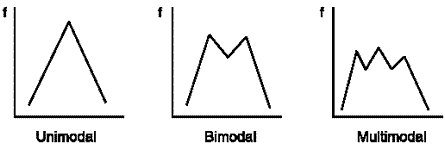
While most distributions that occur in statistical data have but one main peak (unimodal), other distributions may have ii peaks (bimodal) or more than two peaks (multimodal).
Examples of unimodal, bimodal and multimodal line graphs are shown below:
General shape
The 2nd main feature of a distribution is the extent to which it is symmetric.
A perfectly symmetric curve is i in which both sides of the distribution would exactly match the other if the effigy were folded over its key indicate. An example is shown below:
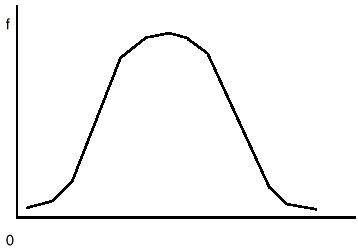
A symmetric, unimodal, bell-shaped distribution—a relatively common occurrence—is chosen a normal distribution.
If the distribution is lop-sided, it is said to be skewed.
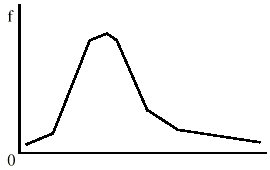
A distribution is said to be skewed to the right, or positively skewed, when most of the data are concentrated on the left of the distribution. Distributions with positive skews are more common than distributions with negative skews.
Income provides one case of a positively skewed distribution. Most people make under $40,000 a yr, only some make quite a flake more, with a smaller number making many millions of dollars a year. Therefore, the positive (right) tail on the line graph for income extends out quite a long way, whereas the negative (left) skew tail stops at zero. The right tail clearly extends further from the distribution's centre than the left tail, as shown below:
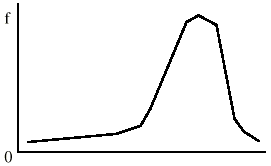
A distribution is said to exist skewed to the left, or negatively skewed, if virtually of the data are full-bodied on the right of the distribution. The left tail clearly extends farther from the distribution's heart than the right tail, every bit shown below:
Middle and spread
Locating the centre (median) of a distribution can be done past counting one-half the observations upwardly from the smallest. Obviously, this method is impracticable for very big sets of data. A stem and leaf plot makes this easy, however, because the information are arranged in ascending society. The mean is another measure of central tendency. (See the chapter on central trend for more detail.)
The amount of distribution spread and any big deviations from the general pattern (outliers) can be quickly spotted on a graph.
Using stem and leaf plots as graphs
A stem and foliage plot is a elementary kind of graph that is made out of the numbers themselves. Information technology is a means of displaying the main features of a distribution. If a stem and foliage plot is turned on its side, it will resemble a bar graph or histogram and provide similar visual information.
Height of Page
Example half-dozen – Using stalk and leaf plots as graph
The results of 41 students' math tests (with a all-time possible score of 70) are recorded below:
31, 49, 19, 62, fifty, 24, 45, 23, 51, 32, 48, 55, 60, 40, 35, 54, 26, 57, 37, 43, 65, l, 55, 18, 53, 41, 50, 34, 67, 56, 44, 4, 54, 57, 39, 52, 45, 35, 51, 63, 42
- Is the variable discrete or continuous? Explain.
- Prepare an ordered stem and foliage plot for the data and briefly depict what information technology shows.
- Are there whatsoever outliers? If so, which scores?
- Look at the stem and leaf plot from the side. Describe the distribution'southward chief features such as:
- number of peaks
- symmetry
- value at the centre of the distribution
Answers
- A exam score is a discrete variable. For example, information technology is not possible to have a examination score of 35.74542341....
- The lowest value is 4 and the highest is 67. Therefore, the stalk and foliage plot that covers this range of values looks similar this:
Tabular array 10. Math scores of 41 students Stem Leaf 0 4 one 8 9 2 three four half dozen three 1 two 4 five 5 seven 9 iv 0 1 ii 3 4 v 5 viii 9 5 0 0 0 1 1 2 3 4 four v 5 6 7 7 half-dozen 0 two iii v seven Note: The annotation two|4 represents stem 2 and leaf four.
The stalk and foliage plot reveals that most students scored in the interval between l and 59. The large number of students who obtained high results could mean that the examination was also easy, that most students knew the material well, or a combination of both.
- The consequence of 4 could be an outlier, since there is a large gap between this and the adjacent result, eighteen.
- If the stem and leafage plot is turned on its side, it will look like the following:
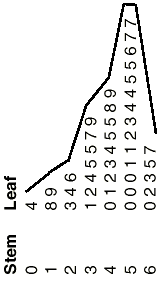
The distribution has a unmarried summit within the l–59 interval.
Although there are only 41 observations, the distribution shows that most data are clustered at the right. The left tail extends farther from the data center than the right tail. Therefore, the distribution is skewed to the left or negatively skewed.
Since there are 41 observations, the distribution middle (the median value) will occur at the 21st observation. Counting 21 observations up from the smallest, the centre is 48. (Note that the same value would have been obtained if 21 observations were counted down from the highest observation.)
How Do You Draw a Stem and Leaf Diagram
Source: https://www150.statcan.gc.ca/n1/edu/power-pouvoir/ch8/5214816-eng.htm
0 Response to "How Do You Draw a Stem and Leaf Diagram"
Post a Comment